
Digitize
We start from your print files or scans of the pages. Every chapter becomes clean web text, with its headings, figures and tables in place and the printed page numbers alongside, so readers can always match the screen to the book.

← Custom apps, AI and data · Digital editions and AI assistants
We turn printed books, manuals and guides into online editions your readers can search and ask questions of, with an AI assistant that answers only from your book and shows the pages it used.
What we build
We start from your print files or scans of the pages. Every chapter becomes clean web text, with its headings, figures and tables in place and the printed page numbers alongside, so readers can always match the screen to the book.
One search box finds passages by keyword and by meaning. The assistant answers plain-language questions using only your book, puts a numbered reference next to every fact and opens the right page in one click.
Decide who gets in: your staff, your members, or readers who bought the book or subscribe, signing in with accounts they already have. Usage limits, answer ratings and a monthly budget alert are built in.
Case study
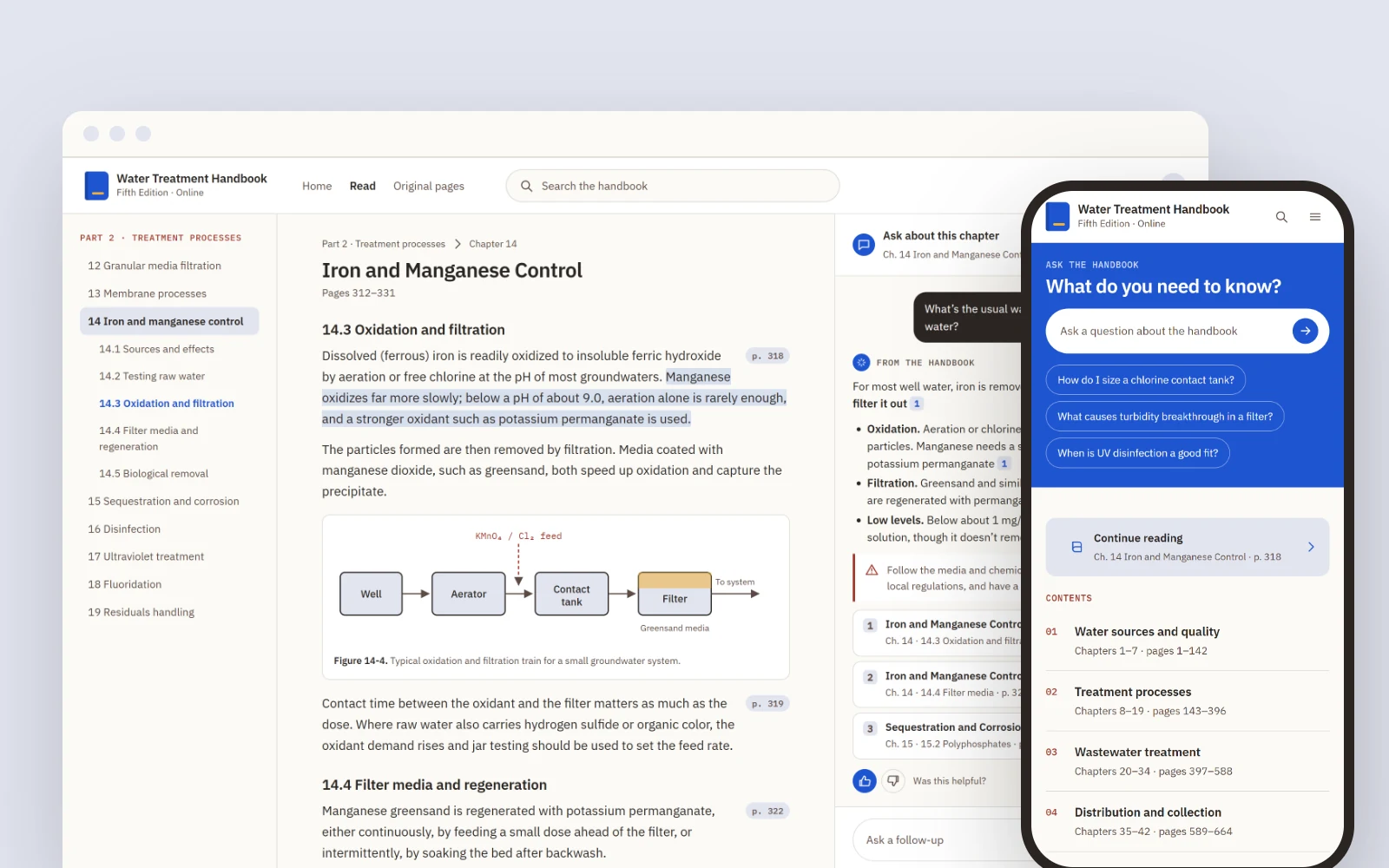
Technical publishing · Custom apps, AI and data
A specialist publisher’s handbook, online for its readers, with an assistant that answers only from the book and links to the pages it used. A working version in a day, about one cent per question, and all twenty test questions handled correctly before launch.
Other kinds of books
The same approach works for almost any book people look things up in. Here are a few examples of the questions readers could ask, and the kind of answer they’d get back.
Example · Employee handbook
A handbook or policy manual that answers staff questions directly, instead of the same questions landing in HR’s inbox every week.
A staff member asks
“How much notice do I need to give for a week off?”
Two weeks for five or more days in a row, approved by your manager [1]. Shorter notice is fine in an emergency [2]. [1] Section 6.2 · p. 31 [2] Section 6.4 · p. 33
Example · Training course and study guide
Course books and certification guides that explain a topic a second way, summarize a chapter or quiz the learner, always from the official material.
A learner asks
“Quiz me on chapter 4 before my exam.”
Five questions from chapter 4, then feedback on each answer, with the page to reread for anything missed. Chapter 4 · pp. 88–117
Example · Out-of-print and archive titles
Older titles that only exist on paper or as scans, turned into searchable text so the knowledge in them can be found again, and even sold again.
A researcher asks
“Which editions mention the 1936 flood?”
Three mentions across two editions, each with the scanned original page alongside the text. 1952 ed. p. 140 · 1978 ed. pp. 212, 215
Example · Field guide or product manual
Guides people use away from a desk, on a phone, in the field or on the shop floor, where flipping through an index isn’t practical.
A technician asks
“What does error code E14 mean, and is it safe to reset?”
The cause, the check to make before resetting, and a reminder to follow the safety steps in the manual. Troubleshooting · p. 76 Safety · p. 4
Built to be trusted
Most projects start with a working version on your own book, so you can try it on real questions before deciding anything else.
Tell us what you publish. We’ll show you what an assistant built on it could do.