

← Work · Technical publishing · Custom apps, AI and data
An AI assistant for a 700-page technical handbook
- Client
- A specialist publisher of technical reference books
- Services
- Custom apps, AI and data
- Timeline
- A working version within a day, then a full product for readers
- 700+printed pages, now searchable and answerable in seconds
- About 1¢in AI costs per question
- 20 of 20test questions handled correctly before launch
The client’s flagship title is a technical handbook for water and wastewater treatment professionals: more than 700 pages and about fifty chapters, with hundreds of figures and tables. Engineers and operators rely on it, but finding one answer meant knowing where to look.
The challenge
The handbook is the result of years of work by dozens of expert authors, and each new edition is a major investment. In print, though, it’s hard to search. A reader with a specific question has to work through the index, then read across several chapters to piece the answer together.
The publisher wanted to know whether AI could make the handbook easier to use without putting its reputation at risk. Their conditions were clear:
- Answers must come from the book. Nothing from the wider internet, and no confident guessing.
- Every answer must be checkable. Readers in this field act on what they read, so they need to see exactly where it came from.
- It has to be a product. Only readers who have bought the handbook or subscribe should get in, and running costs had to stay low enough to sell it profitably.
Putting the book online
We started with the final print file. Our pipeline turned every chapter into clean web text, with its headings, figures and tables in place and the printed page numbers in the margin, so a reader can always match what’s on screen to the book on their desk. Every original printed page is there too, exactly as it appears in print.
On top of that, a single search box finds passages by keyword and by meaning. A search for “removing iron from well water” turns up the right sections even when they use different words.
An assistant that shows its sources
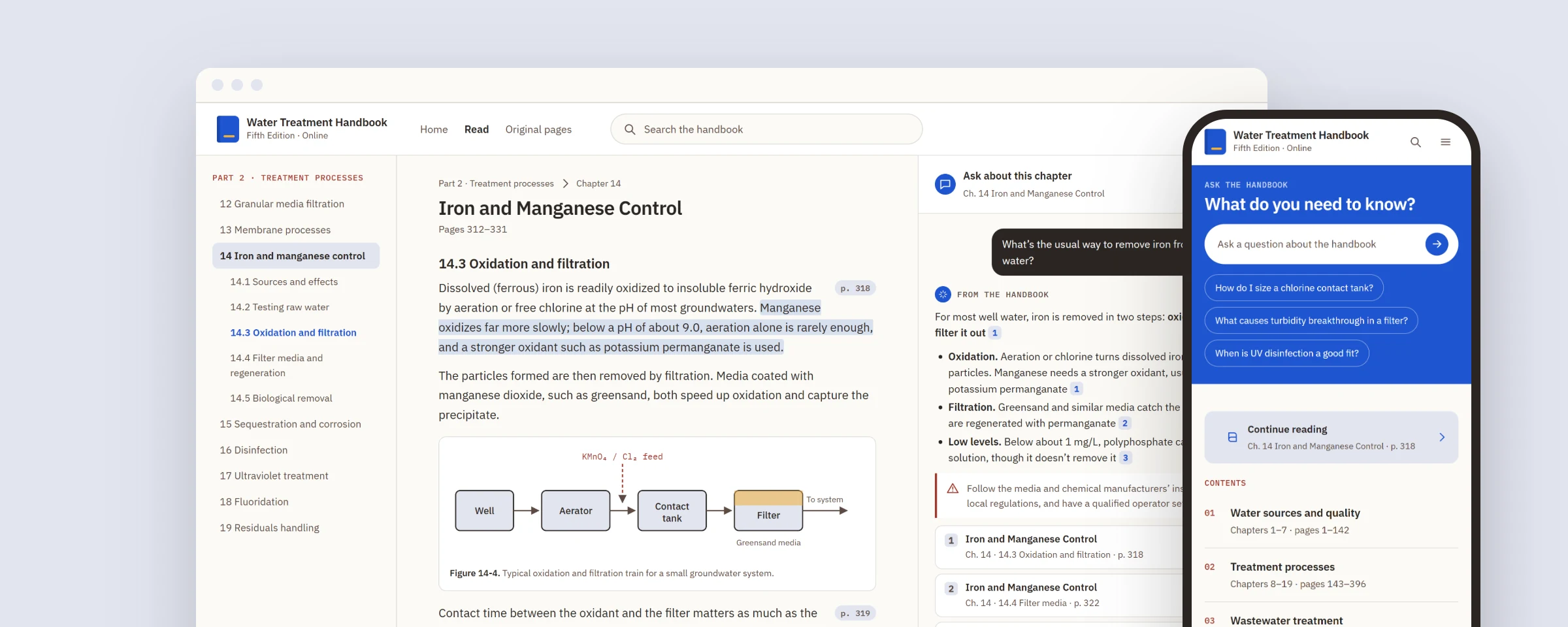
The heart of the project is an assistant that answers questions in plain language, using only the handbook:
- Each answer is built from the most relevant passages in the book, with numbered references next to every fact.
- Each reference names the chapter and printed page, and one click opens the book at that page.
- Follow-up questions build on the conversation, the way they would with a colleague.
- While reading, a reader can ask about the chapter they’re on (“summarize this chapter”) or highlight a passage and ask about it.
Why sources matter
AI can be wrong. Showing the exact pages behind every answer means readers never have to take it on trust: they can check the book in one click.
Inside the product
The whole handbook, one question away.
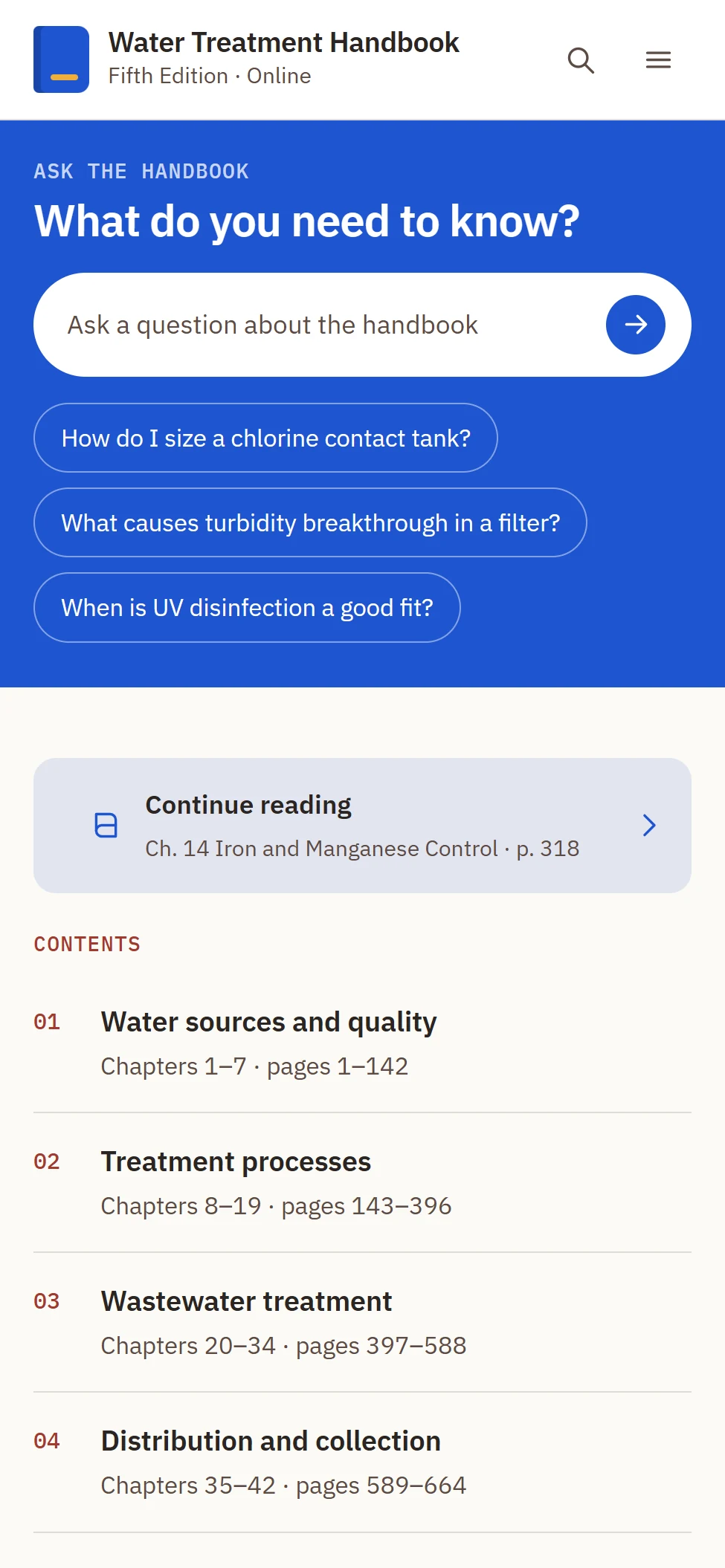
Ask
A question box up front, with ideas to get started and the contents below.
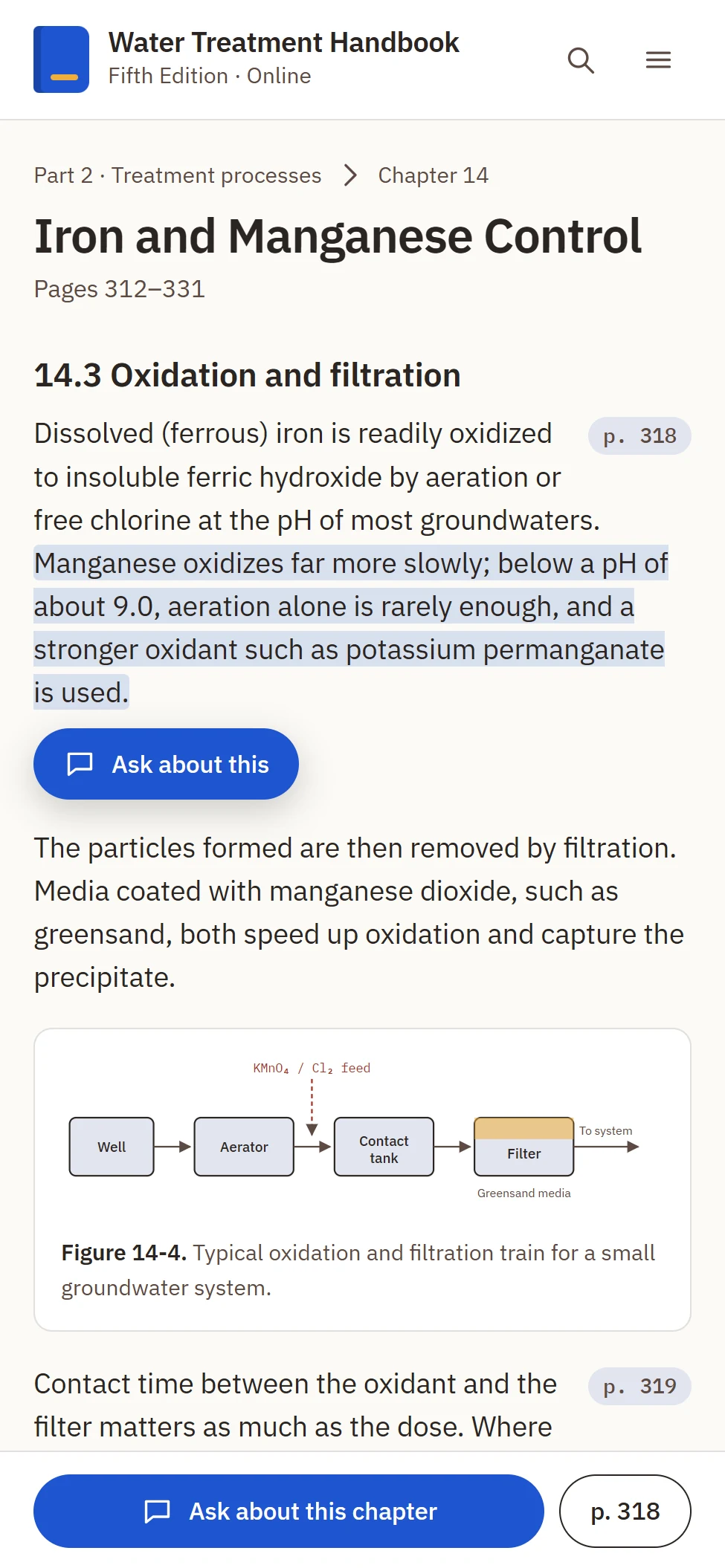
Read
Every chapter, figure and table, with the printed page numbers alongside.
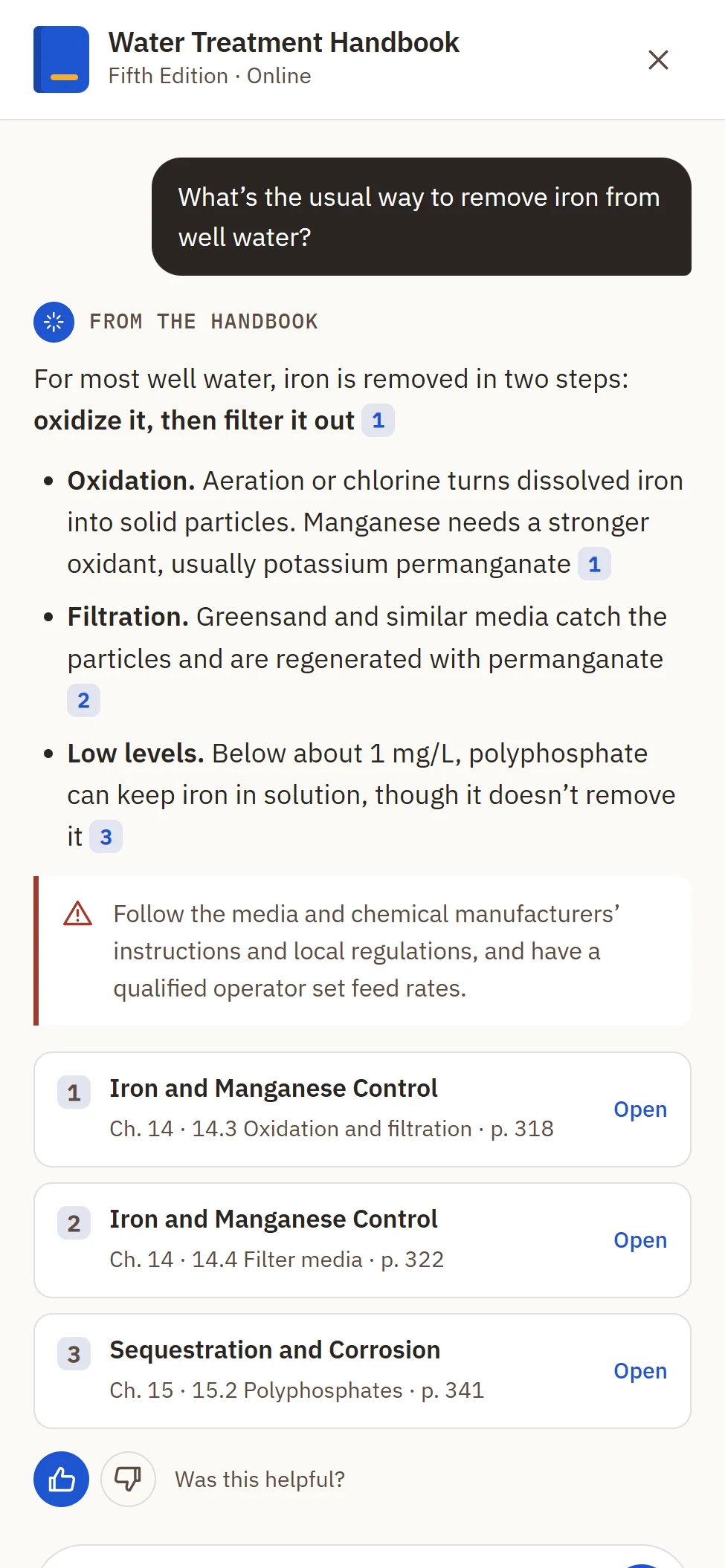
Answer
Plain answers, every fact referenced, and the pages one tap away.
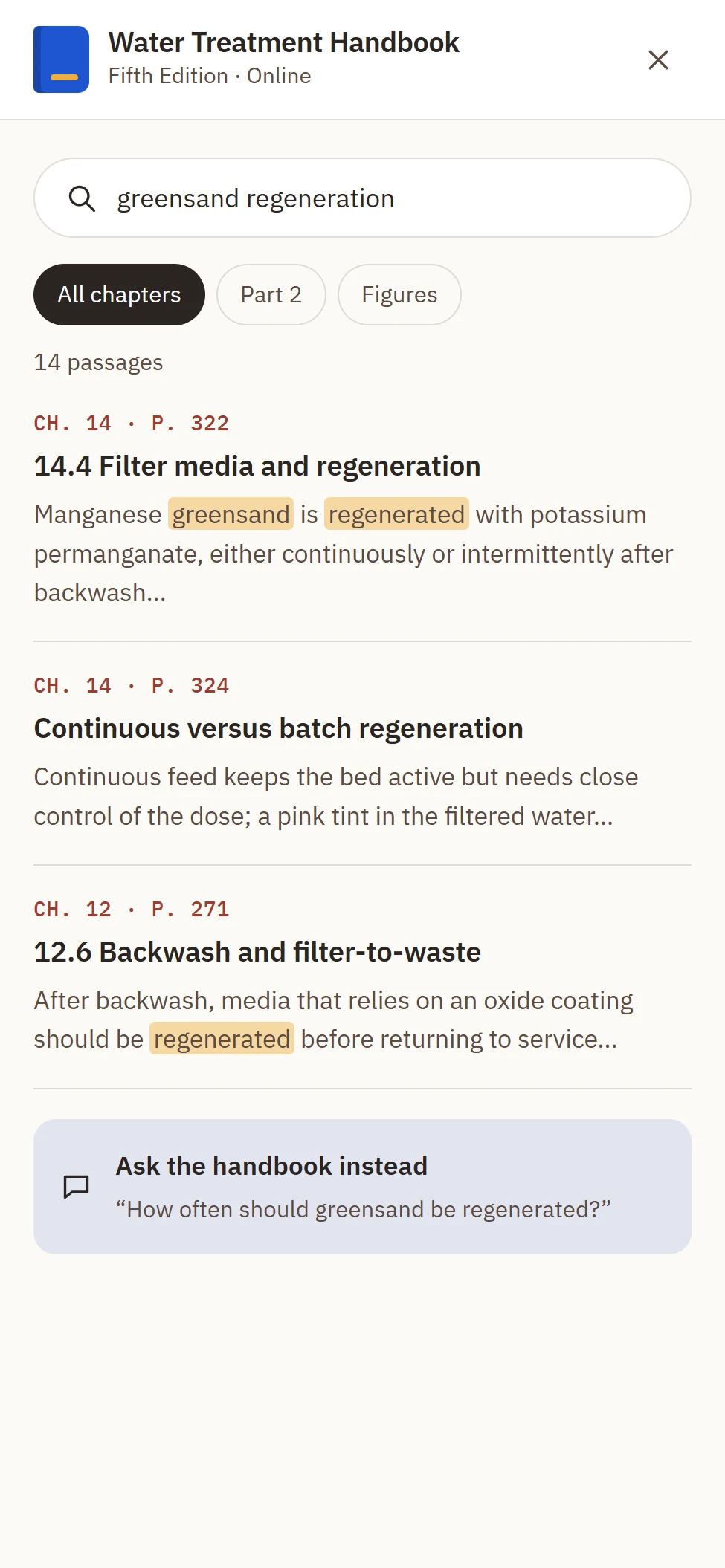
Search
Find passages by keyword or meaning, right down to the page.
Built for paying readers
We started with a working version for the publisher’s own team, built in a day, so they could try it on real questions before committing to anything. Once they were happy, we turned it into a product for their readers:
- Readers sign in with the account they already have on the publisher’s website. There’s no new password to remember.
- Access follows what they’ve bought: the online handbook and assistant come with a subscription or a purchase of the book, checked automatically at sign-in.
- The content is protected, with fair-use limits per reader and no bulk download of the printed pages.
- Readers can rate each answer and leave a comment, so the publisher can see what works and where answers need improving.
- It runs in the publisher’s own cloud account, with monitoring so problems are spotted before readers notice.
Keeping it trustworthy
A technical publisher’s name is on every answer, so we built in clear rules:
- If the handbook doesn’t cover something, the assistant says so rather than guessing.
- For safety-critical work, it reminds readers to follow the manufacturer’s instructions and local codes, and to use qualified people.
- It politely declines questions that have nothing to do with the book, and attempts to trick it into misbehaving are blocked.
- Conversations aren’t kept, apart from answers a reader chooses to rate, and the AI service doesn’t use any of it to train its models.
Before launch, we tested it with twenty questions: topics from across the book, follow-ups, a chapter summary, something the book doesn’t cover, an off-topic request and an attempt to trick it. It handled all twenty correctly.
Keeping it affordable
A single handbook doesn’t need a costly search service. We built the search into the app itself, which saved around $75 a month before the first question was asked. The AI costs about one cent per question, so even busy months cost little, and a monthly budget alert keeps spending visible.
The result
- Readers can read, search and question the whole handbook online, on a computer or a phone.
- Every answer comes with the pages it’s based on, one click away.
- The assistant stays within the book, and says so when it can’t help.
- Running costs are measured in cents, not hundreds of dollars.
- The publisher has a new digital product that adds value to every subscription and every copy sold.
Is your content ready for AI?
If your organization publishes guides, manuals, standards or training materials, a few questions are worth asking:
- How do readers find answers today? If the honest answer is “the index,” there’s room to help.
- Could every answer be traced to a page? Content with clear chapters and page numbers is a strong starting point.
- Who should have access? Staff, customers or subscribers can each have their own way in, linked to the accounts they already have.
We’re happy to talk it through.
Some details, including the client’s industry, have been changed to protect their privacy.
Have content your readers struggle to search?
Tell us what you publish. We’ll show you what an assistant built on it could do.